Three weeks after the first US Army units arrived on the outskirts of Brest, the Americans launched their assault on the city on 26 August in a gruelling and bitter battle to overcome the garrison’s well-prepared defences based around Vauban’s original 18th century fortifications.
A week later on 2 September, some 500km away to the east at Bourg Achard, near Rouen, B Squadron of the 141st Regiment, Royal Armoured Corps (The Buffs) were preparing to cross the Seine but received orders to join the US forces attacking Brest.

The 141st was a specialised British unit equipped with a mix of 39 ton Churchill tanks; the standard 75mm gun tank, as well as the 95mm “Close Support” tank fitted with a more powerful howitzer gun. Most important it had the Crocodile flamethrower tank designed to overcome entrenched fortified positions. At the time only the British Army had developed and deployed this capability. The Churchill was also renowned for its cross-country capability.
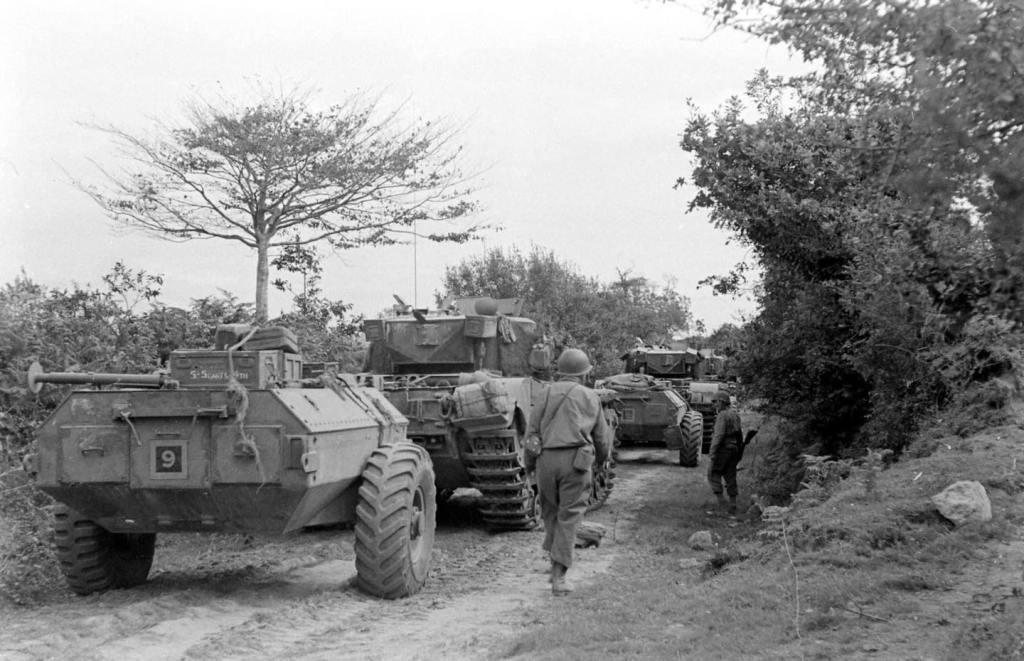
The journey to Brittany by tank transporter took 4 days. The advance party arrived in Lesneven on 7th September and the whole Squadron (15 Crocodile tanks) assembled at Le Folgoët the following day.
The tanks were fitted with “Rhinoceros” hedge cutters built on the spot to go through the many small field “Talus” (dykes) and began training with the US Infantry who had never operated with specialised tanks.
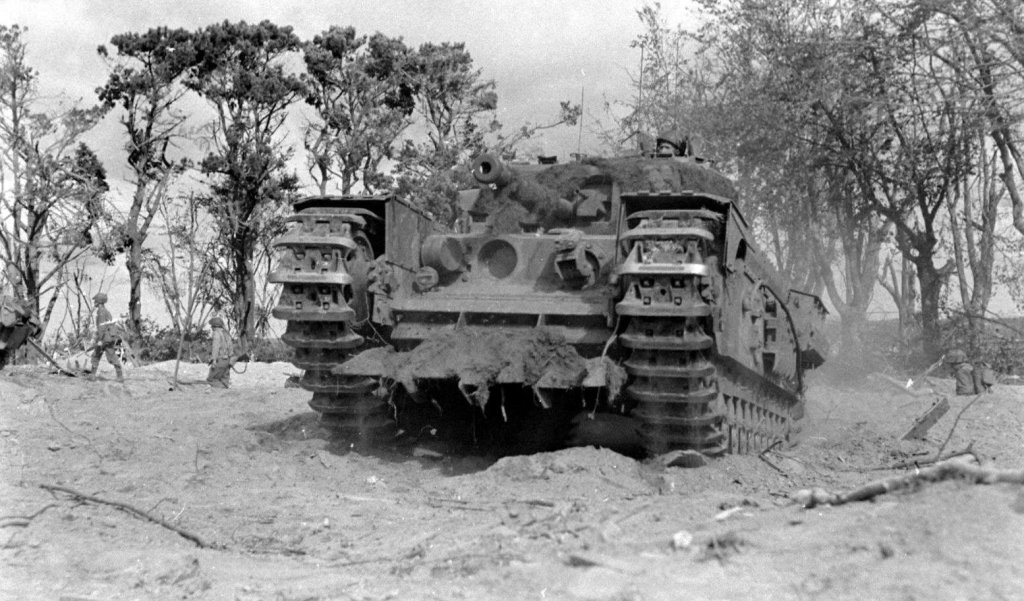
The first target Lambezellec was called off in favour of an attack on Fort Montbarey. The outer defences of the Montbarey were extremely strong. Not only the massive granite walls several meters thick but the Germans had installed a colossal minefield of 140kg naval shells, then a wide anti-tank ditch plus 3 lines of defence defended by machine guns, 40mm and 20mm cannon, in bunkers. The whole of this area was so cratered as to be almost impassable by ordinary tanks. The fort itself, defended by a mix of units around a core of German “Fallschirmjâgers” paratroops was surrounded by sunken roads and a moat 12m wide and 6m deep.
In the early morning of 14 September, the tanks of 8 Troop under command of Lt Anthony Ward moved into position. The attack on the fort took 3 days (for a detailed account see here) But on 16th September the German defenders finally surrendered. It was the beginning of the end. On 18th September the city garrison followed suit. The German Commander Gen Ramcke who had escaped across the Bay formally surrendered on 19th September.
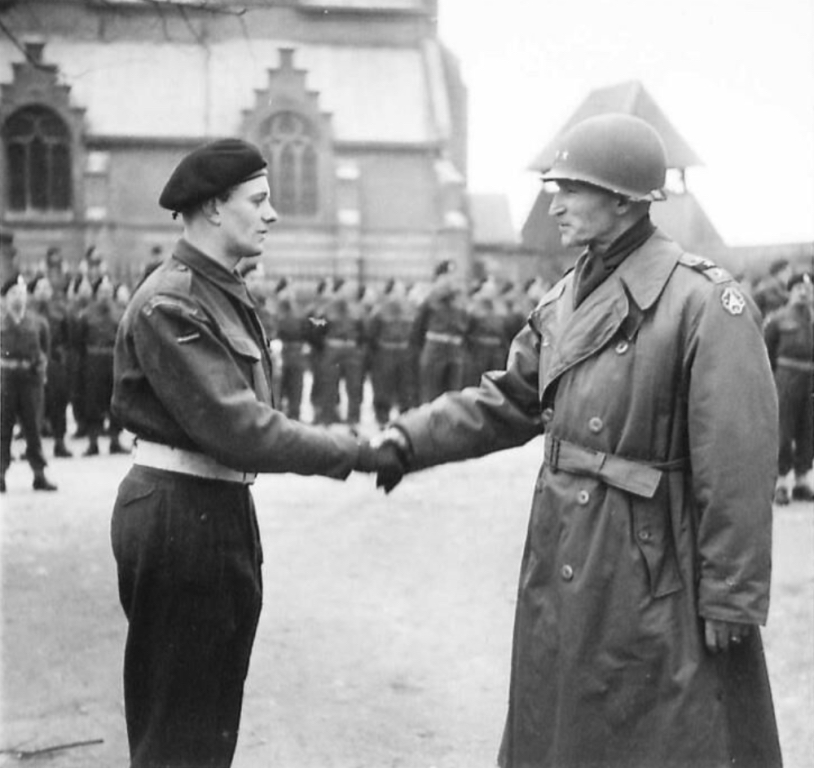
The US Army was generous in recognising the role played by the men of 141 RAC to overcome the German garrison. Lt Ward was awarded a Silver Star and 13 others received the Bronze Star; the highest number ever given to a single British army unit. Gen. William Sands of the US 29th Division wrote later to praise “the great courage displayed by the British unit and the US Infantry”.
Today little remains to remind us of this distant conflict. Fort Montbarey continued as a military base until the late 1960’s. It is now a museum where a Churchill Crocodile is on display. A small display contains Lt Wards medals. The bodies of the British and American soldiers who lost their lives were later reburied in CWGC and ABMC cemeteries in Normandy.
Acknowledgements: Special thanks to the team at Bovington Tank Museum, Montbarey Museum and the National Army Museum, and to Robert Le Chantoux, Grahame Eckworth, Nick Howes, Ken Lynn, David Page, John Smith, and Mike’s Research.
 brittanyremembers.com